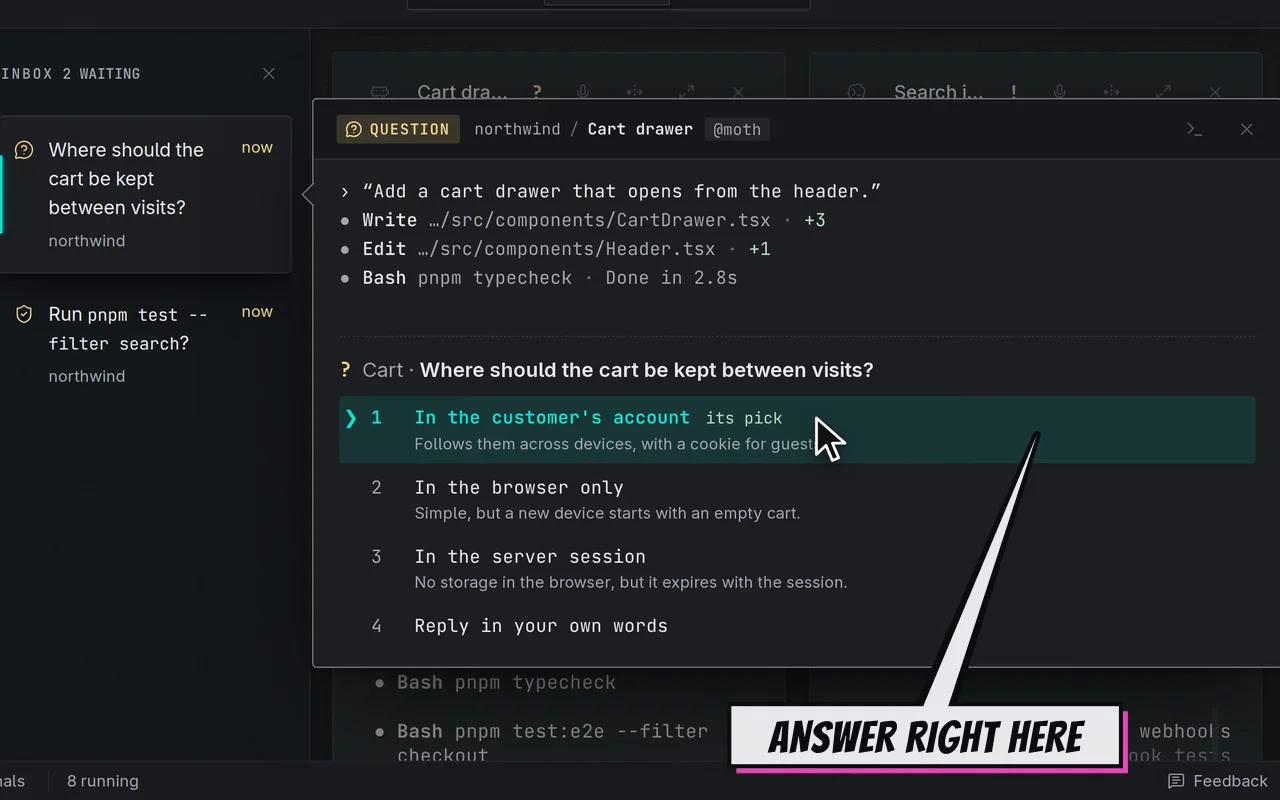
Novadeck vs Orca: In Orca, you go to each agent to answer it. In Novadeck, their questions come to one Inbox.
Both run the real Claude Code, Codex and Antigravity on your own plans. In Orca, you answer each agent in its own terminal, from its tab or the Agents feed, or in its chat on the phone app; in Novadeck, its question waits in one Inbox with the answers as buttons.
# free · open source (GPL) · no account · no telemetry, just an update check · macOS, Windows, Linux
Answering from the Inbox
Claude asks a question and Codex asks to run its tests. You answer both from the Inbox, and they carry on without you opening either terminal. Each agent tells Novadeck it’s asking through its own hooks or status line, and the answers are the ones its terminal offers.
How a session goes
In OrcaIn Novadeck
While they work
In Orca · Each task gets its own worktree. The sidebar marks every task working, waiting or done, and an experimental dashboard shows them as cards. To compare agents, you can send one prompt to several and keep the best.
In Novadeck · You see your agents side by side on a grid or a canvas, whatever task each is on, or focus on one.
Working together
In Orca · Agents use Orca’s CLI to start another agent in a child worktree or to message any terminal, and an experimental mode adds a coordinator whose workers report back to it.
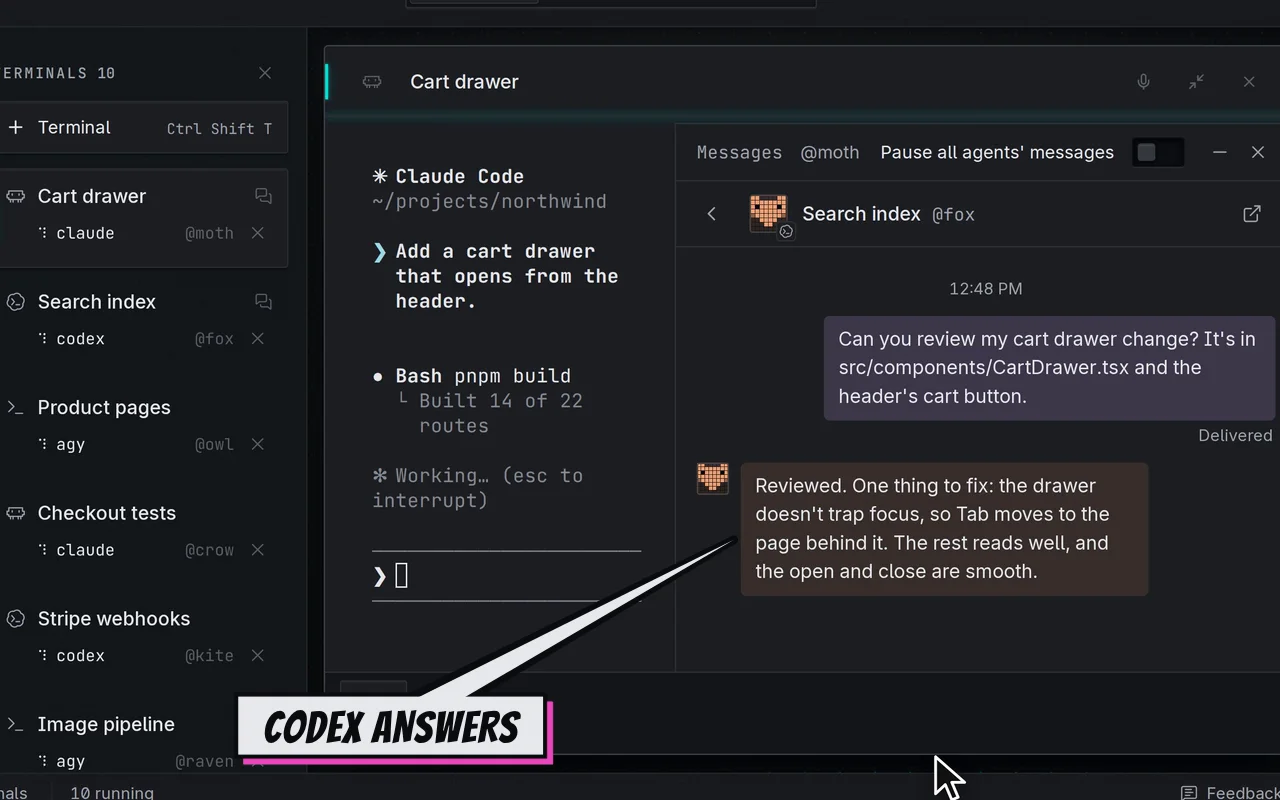
In Novadeck · Claude can open Codex to review its work: Codex starts in its own terminal, joined to Claude’s by a line, and reads the work before you do. You can read what they said to each other.
When one needs you or finishes
In Orca · Orca lists it in the Agents feed, beside its live terminal, and can ping you. You answer in its terminal, or with a short reply from Orca’s phone app. When it’s done, you read its diff in the worktree and open the PR from Orca.
In Novadeck · You get a ping, and its question or command request waits in your Inbox: pick an answer or type your own. When it’s done, its report lands there too, and its diff can open beside its terminal. On full autonomy, command requests stop, but questions and reports still land there.
A review between two agents
Claude asks Codex to review its change, and Codex answers. Beside Claude’s terminal, their exchange reads as a conversation.
What each one is betting on
Orca
Orca bets on output: run more agents at once, keep the way from issue to merged PR in one app, and you ship more.
Novadeck
Novadeck bets your attention is the limit, not the number of agents, so it works on interrupting you less rather than on running more of them.
Still deciding?
Pick Orca if you
>think in tasks and PRs, and want the way from issue to merged PR in one app
>want to race a few agents on one task and keep the best
>want to check on agents from your phone, or run them over SSH
>use agents beyond Claude Code, Codex and Antigravity
Pick Novadeck if you
>want what agents ask to land in one Inbox, and answer most of it right there
>want agents from different tasks on one grid or canvas
>want an agent’s reviewer beside it on screen, and what they said kept in one place
Trying Novadeck moves nothing: your agents run in it as they are, on your own plans, with their own settings, and disconnecting one takes Novadeck back off it.
>What gets installed?
Connecting an agent installs one Novadeck plugin, an MCP server and hooks, with that agent’s own plugin command, and disconnecting uninstalls it. In Antigravity, Novadeck shows its own status line before yours (on Windows, if you have your own, it’s left alone), and disconnecting puts yours back.